
New: A scan of 475 UK websites reveals major accessibility gaps
View ReportREPORT
2026 Digital Accessibility Index: A Nordic Perspective
Nordic sites all rank among Europe’s least accessible websites, averaging 22% more issues than the rest of the EU and UK

On this page
For most of the past decade, Denmark, Sweden, and Finland have required public-sector websites to be accessible. Since June 2025, the European Accessibility Act (EAA) has extended similar requirements to many private businesses, from online shops to banks.
Enforcement is starting to build across the EU. In France, the first lawsuits under the Act were filed within five months of it taking effect. In Sweden, the national regulator has begun inspecting online retailers.
At the same time, AI is changing how people find websites. AI-referred traffic grew 632% in the last year(opens in a new tab). About two-thirds of it lands on interior pages instead of the homepage. Any page can now be a customer's first, and sometimes only, stop, so organisations need to think about accessibility across their entire site.
As part of AudioEye’s 2026 Digital Accessibility Index, we scanned 5,440 pages from 178 Danish, Swedish, and Finnish sites. The results show that these sites, like those across the rest of the EU and UK, still struggle with accessibility.
KEY FINDINGS
Nordic countries are among the countries with the most issues. Of the 12 EU and UK countries we compared, Denmark averages the most issues per page (87.6). Sweden (79.8) and Finland (77.0) rank third and fourth.
Four problems make up more than 80% of the issues. Page structure that isn’t clear to assistive technology, links that open new tabs without warning, unlabelled buttons and form fields, and images without useful descriptions account for most of what we found.
The pages AI search favours have more issues. On Nordic sites, interior pages average 82.8 issues per page, 11% more than homepages.
EAA enforcement has started in the Nordics. Sweden’s regulator has opened 28 cases against online retailers, and fines can reach SEK 10 million. Regulators in Denmark and Finland can order businesses to fix issues, and breaches can lead to fines.
1. Nordic Pages Average 22% More Issues Than the Rest of the EU and UK
Among the 12 EU and UK countries in our comparison, Denmark, Sweden, and Finland are among the five with the most accessibility issues per page. Denmark is at the top with 876 issues per page, with Sweden (79.8) and Finland (77.0) close behind.
Most Issues Per Page, By CountrySource: AudioEye 2026 Digital Accessibility Index, by-country analysis.
Together, Nordic pages average 82.7 issues per page, compared with 67.6 across the rest of the EU and UK. That is about 22% more issues per page.
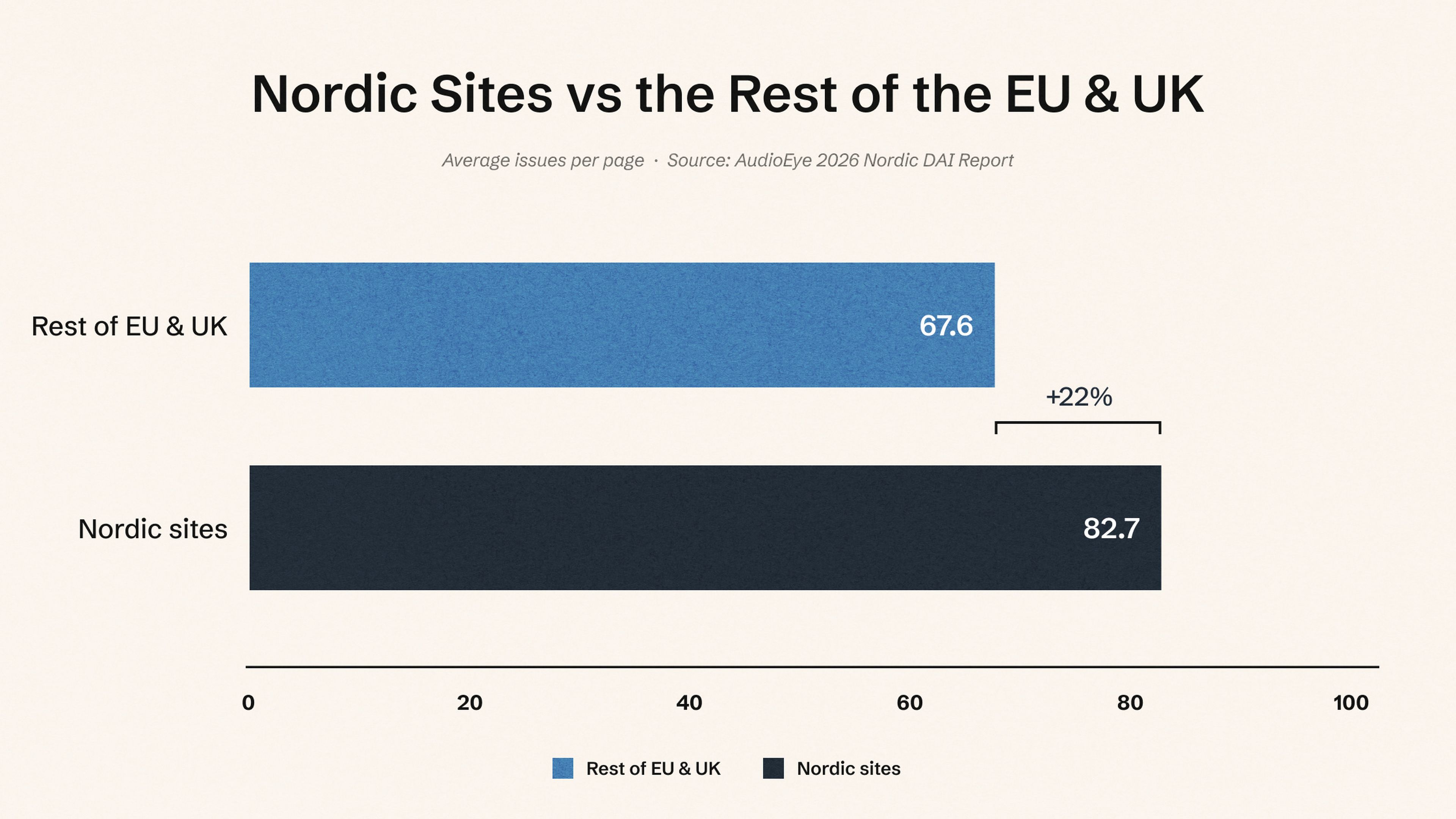
That result stands out for a region with a strong reputation for accessibility. Ahead of the EAA, Nexer Digital placed Denmark, Sweden, and Finland in its top tier for accessibility maturity(opens in a new tab), alongside the UK.
One possible reason for the difference is what each measure looks at. Nexer's ranking draws on factors such as each country's adoption of the Web Accessibility Directive, which covers public-sector websites. Most of the sites in our Nordic scan belong to private businesses, and those sites had far more issues. Public-sector pages averaged 54.5 issues per page. Private-sector pages averaged 87.9, about 61% more.
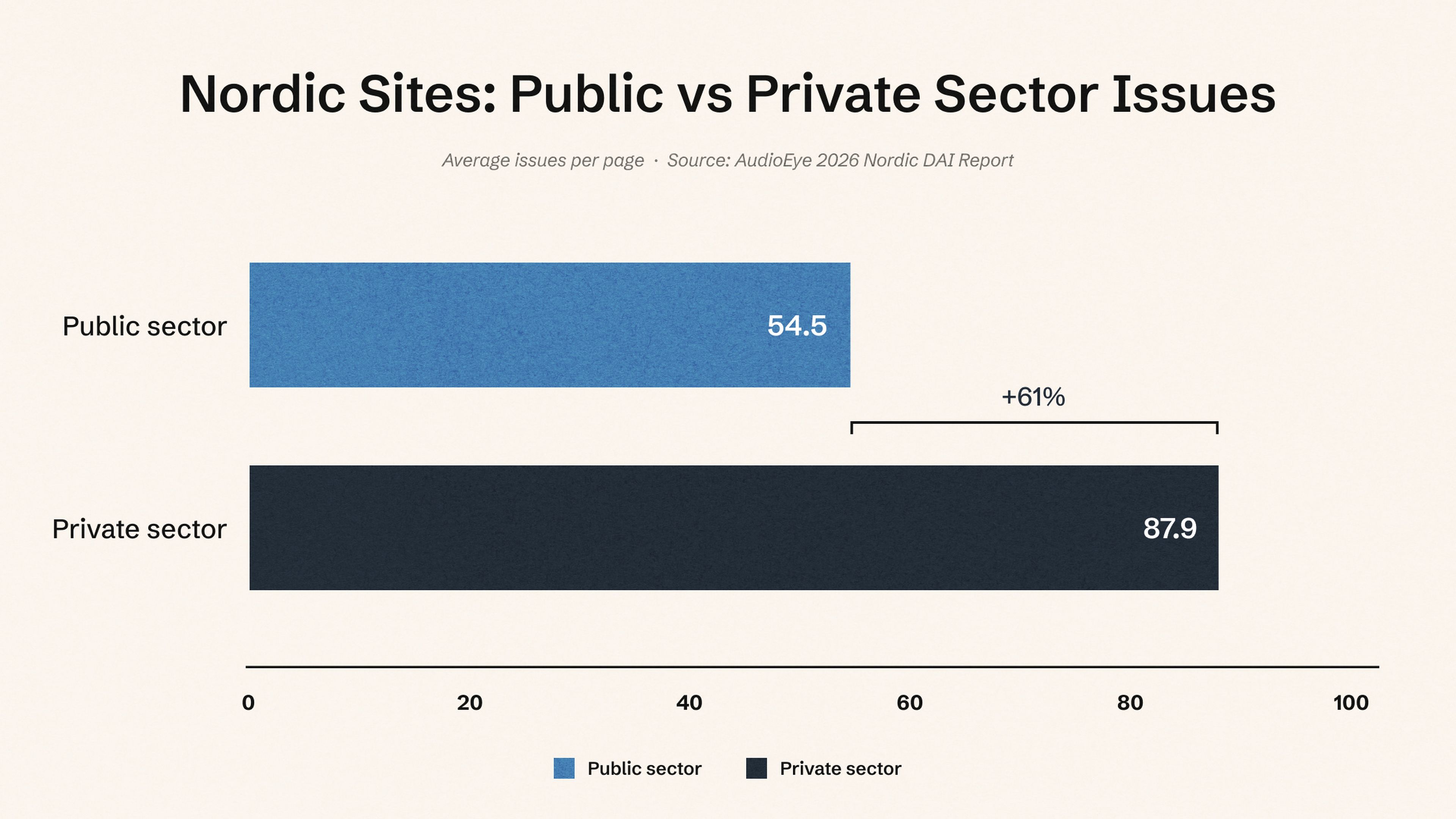
Sweden’s Post and Telecom Authority (PTS) has seen the same pattern. When it measured 576 Swedish websites across nine sectors in 2025(opens in a new tab)(downloads a file), it consistently found more accessibility issues on private sector sites and suggested the public sector’s longer history of legal requirements was a likely reason.
Whatever the cause, Nordic organisations have ground to make up as EAA enforcement ramps up, especially in the private sector. The good news is that most of the issues we found come from four common problems, so focusing on those could address the bulk of them.
2. Four Problems Account for More Than 80% of the Issues
Most of the issues on Nordic pages came from four types of problems:
Page structure that isn't clear to assistive technology (27.8 per page)
Headings, lists, tables, and form fields can look right on screen without being set up for assistive technology. For example, a section title might be styled in large, bold text so it looks like a heading, while the code treats it as ordinary text. Screen reader users often move through a page by jumping from heading to heading, so they can skip right past that section.Links that open a new tab or window without warning (14.3 per page)
Some links open a new tab or window without telling the user it will happen. For example, a “Delivery Options” link might open in a new tab. A sighted visitor sees the new tab appear. A screen reader user may not realise they've left the original page, and the “Back” button won't return them to it.
Buttons and controls without a label (11.7 per page)
Buttons, form fields, and other controls need a text label that assistive technology can read. For example, a shopping basket button might show only a basket icon. A screen reader may announce it simply as “button,” leaving the user unsure whether it opens the basket, a menu, or a search field. In the same way, a form field without a label can leave a user guessing what to enter.
Images without a useful description (11.4 per page)
Images need a short text description, called alt text, that screen readers read aloud. For example, a product photo might show the available colours, or a banner might include a discount code. Without alt text, a screen reader user misses that information.
Some of these issues can be fixed automatically. Others need human judgment. A tool can detect an image with no description, but it can't reliably write one that explains what the image shows. The same goes for deciding how a page's headings should be organised, or what a button's label should say. When teams rely only on simple automated tools, issues like these can go unresolved, which may help explain why they show up so often.
3. The Pages AI Search Favours Have More Issues
For years, many accessibility programmes focused on the homepage and a few key pages. Visitors typically landed on the homepage and followed one of a few predictable paths to conversion.
AI search is changing that. About two-thirds of AI-referred visits now land on interior pages instead of the homepage.
Those visitors appear to arrive with a clear purpose. As Previsible's 2025 AI SEO Study Report put it, AI “doesn't send users to browse. It sends them to compare, evaluate, and decide.” In 2025, conversion rates for AI-referred traffic rose 55% year over year.
On Nordic sites, those interior pages are where visitors are more likely to run into accessibility issues. Interior pages average 82.8 issues per page, compared with 74.3 on homepages. That is about 11% more issues on the pages AI search favours.
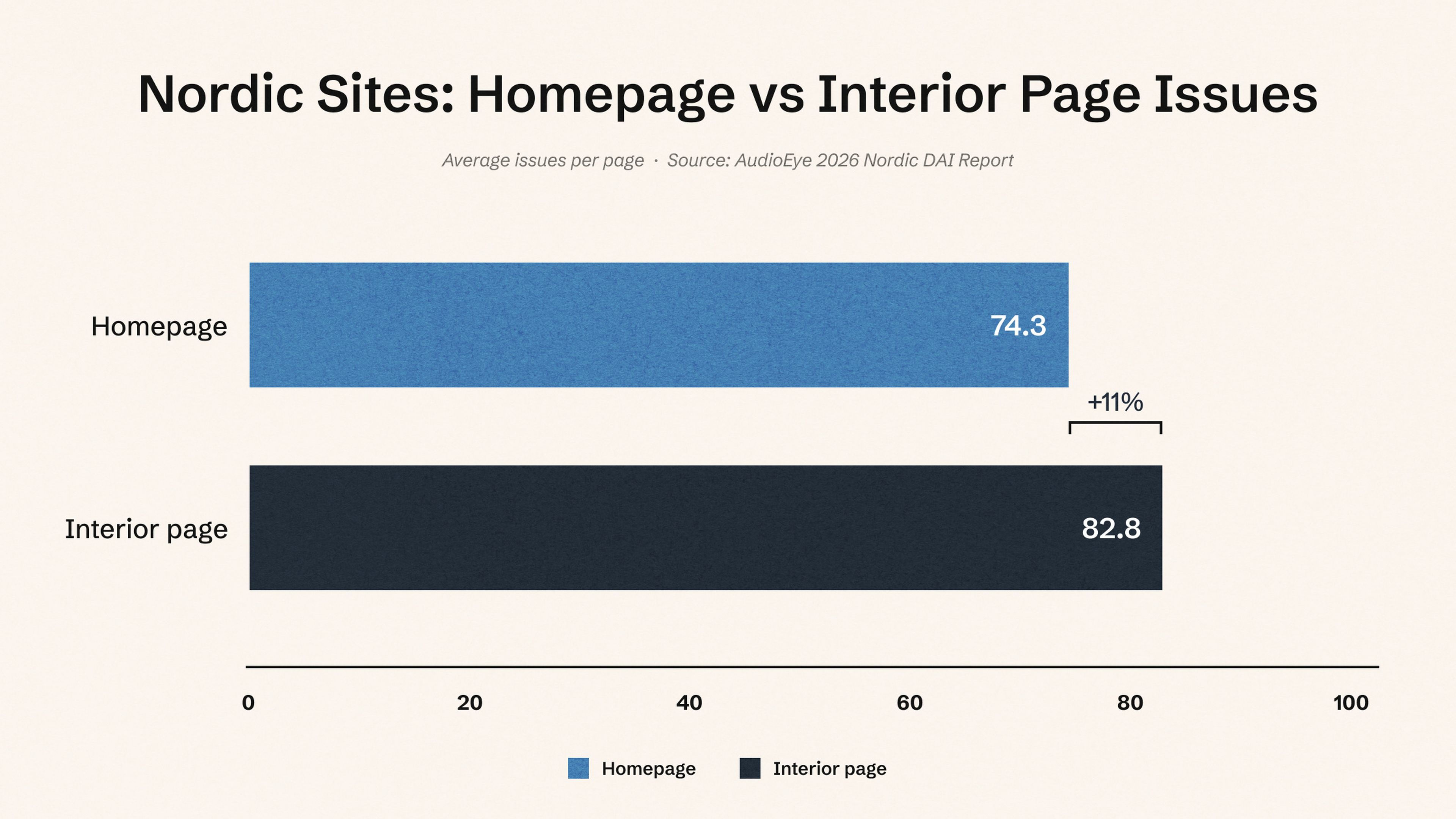
These issues can make tasks more difficult to complete for people with disabilities. They can also increase legal risk. In the United States, 64% of web accessibility lawsuits in 2025 cited issues on interior pages. As EAA enforcement grows, organisations in the EU may see a similar pattern.
For organisations, that means their accessibility programme needs to cover all of the pages a customer might reach. An approach built around periodic reviews of a few key pages is hard to stretch that far. But relying on general-purpose AI tools to build accessible pages by default isn't the answer either. When we asked five of these tools to build websites that meet WCAG 2.2 AA, their sites averaged about 50 medium- or high-severity issues per page.
4. EAA Enforcement Has Started in the Nordics
The first signs of EAA enforcement are already visible. In France, disability rights groups brought the first lawsuits under the Act in November 2025. In Sweden, PTS began inspecting online retailers on its own initiative in October 2025 and had opened 28 cases by March 2026. In September 2026, it extended its supervision to banking services. None of these cases had led to a penalty as of September 2026, but they show that enforcement can begin without a customer complaint.
Denmark's regulator is taking a similar approach. The Danish Business Authority lists online inspections of e-commerce services as part of how it supervises the EAA. In the US, retail brands faced 79% of web accessibility claims in 2025, according to AudioEye's 2026 Web Accessibility Litigation Report.
Online retailers may also have more to fix. When PTS measured Swedish websites in 2025, it found that grocery sites with online shopping had more than three times as many issues per page as grocery sites without. Together, these signals suggest online retail is likely to remain an early focus for enforcement.
In the Nordics, each country enforces the EAA through its own national law and authorities. For a full breakdown of what the EAA requires, read our guide to the European Accessibility Act.
Sweden
The Act on Accessibility to Digital Public Services(opens in a new tab) has covered public-sector websites since 2019. In 2025, the Act on the Accessibility of Certain Products and Services(opens in a new tab) (2023:254) brought the EAA into Swedish law, extending requirements to many private businesses. Under it, PTS supervises e-commerce, banking, and electronic communications services and can impose sanction fees from SEK 10,000 to SEK 10 million.
DENMARK
The Web Accessibility Act(opens in a new tab) has covered public-sector websites and apps since 2018. Since 2025, the Accessibility Act has brought the EAA into Danish law and extended requirements to many private businesses. The Danish Business Authority supervises e-commerce and banking services under this law and can order businesses to fix issues. Deliberate or repeated breaches can be reported to the police and lead to a fine.
Sweden
The Act on the Provision of Digital Services(opens in a new tab) has covered public bodies since 2019. Since 2025, the same law has also covered online shops and other private services under the EAA. The Finnish Transport and Communications Agency (Traficom) supervises these services and can order businesses to fix issues, backed by a conditional fine.
Where to Start
Nordic organisations already have a lot to build on. Each country had accessibility laws in place before the EAA, and the region has a strong reputation for accessibility maturity. The findings in this report show where to focus that effort next.
Start with the pages your customers land on. Check your analytics for your most-visited pages, especially those reached through AI search. Run them through AudioEye's free accessibility scanner. Previsible's data suggests visitors from AI search arrive ready to act, so improving these pages gives more of them a chance to finish what they came to do.
Address the four most common issues first. Page structure, links that open new windows without warning, unlabelled buttons and form fields, and image descriptions account for more than 80% of the issues on Nordic pages. Many websites build their pages from shared templates, so fixing an issue in a template can fix it on every page that uses it. Focusing here can reduce the largest share of issues on a site, which can lower legal risk as EAA enforcement grows.
Pair automated scanning with expert review. Sites change often, and more pages are now built and updated with AI. In AudioEye's survey, nearly 40% of AI users said they don't review AI-generated work any differently from the rest. Automated scanning can flag issues across every page, while expert review helps with the judgment calls, such as whether a button's label tells a customer what it does. Together, they help organisations keep up with EAA requirements as their sites change.
These steps can help Nordic organisations lower their legal risk and make their sites easier for people with disabilities to use. They can also help AI agents that browse and research on someone's behalf. In a recent AudioEye study, AI agents completed 96% of their tasks on one site with accessibility fixes in place and 31% with the fixes turned off.
Methodology
Findings are drawn from AudioEye's 2026 Digital Accessibility Index, based on automated scans of 5,440 pages across 178 websites in Denmark, Sweden, and Finland, benchmarked against the full 2026 Index of 166,457 pages across 6,161 domains globally. Iceland and Norway were not included. Comparisons with the rest of the EU and UK use 58,415 pages from the nine other countries in the index. Issue shares are based on the total number of issues recorded on Nordic pages. AI search traffic figures are from Previsible's 2025 AI SEO Study, and AI tool results are from AudioEye's 2026 study of five general-purpose AI tools. Automated scanning detects a subset of Web Content Accessibility Guidelines (WCAG) criteria, so actual issue counts are likely higher than reported here.
AudioEye's AI agent study sent more than 1,500 AI agents to complete everyday tasks on six websites, each tested with and without accessibility fixes, across six commercial AI models.