
NEW: AudioEye launches Agentic Audits and SDK MCP
Read moreAccessibility: The Missing Piece of AI-Readiness for Saas Companies
AI-readiness starts with accessibility. AI tools and agents rely on the same structure people using assistive technology do: readable text, not baked into images, descriptive alt text, clear headings, and labeled buttons and form fields. When SaaS pricing, feature, and integration pages are inaccessible, AI can’t read, compare, or recommend those vendors to buyers. See how buyers shortlist with AI, what it sees on your key pages, and the simple fixes that matter most below.
Author: Missy Jensen, Senior Content Strategist: AI Search and Discovery
Published: 11/06/2026

Someone types “Compare the top three project management tools for a 200-person team that integrates with Salesforce” into their AI tool of choice. A shortlist of software vendors pops up in seconds, and the person starts digging through the results without ever visiting a single vendor’s site.
That shortlist isn’t built from ads, rankings, or brand awareness (though they do play a part). It’s built from what AI could read on a vendor’s site, and for many SaaS companies, that’s less than they think: pricing that’s locked in graphics, features shown only as icons, integrations shown just as logos. Even the best-optimized content won’t help if AI engines can’t read the page it’s on.
Digital accessibility best practices ensure those pages are readable. That’s where AI-readiness starts.
The Shortlist Moved
Software buying used to start with a search engine and a stack of open tabs. Now it starts with a prompt. According to G2’s 2026 buyer research(opens in a new tab), 51% of B2B software buyers start their research with an AI chatbot more often than with Google, and AI chatbots are now the top influence on which vendors make the shortlist.
That influence changes outcomes. Sixty-nine percent of buyers said AI led them to a different vendor than they planned to choose, and 33% bought from a vendor they’d never heard of before.
AI put those vendors on the list. If it leaves you off, you’re out of the deal.
Most SaaS Companies Know It, and Aren't Ready
Marketing leaders aren’t missing the shift. In Gartner’s 2026 CMO Spend Survey(opens in a new tab), 70% of CMOs said becoming an AI leader is a critical goal for the year, but only 30% said their AI-readiness capabilities are mature. To close that gap, most teams start with content: answer-first writing, comparison pages, FAQs, and more reviews. Those help. But only if AI can read the page they’re on.
That part comes down to digital accessibility.
AI Reads What Accessibility Builds
Not all AI reads a website the same way, and the difference matters.
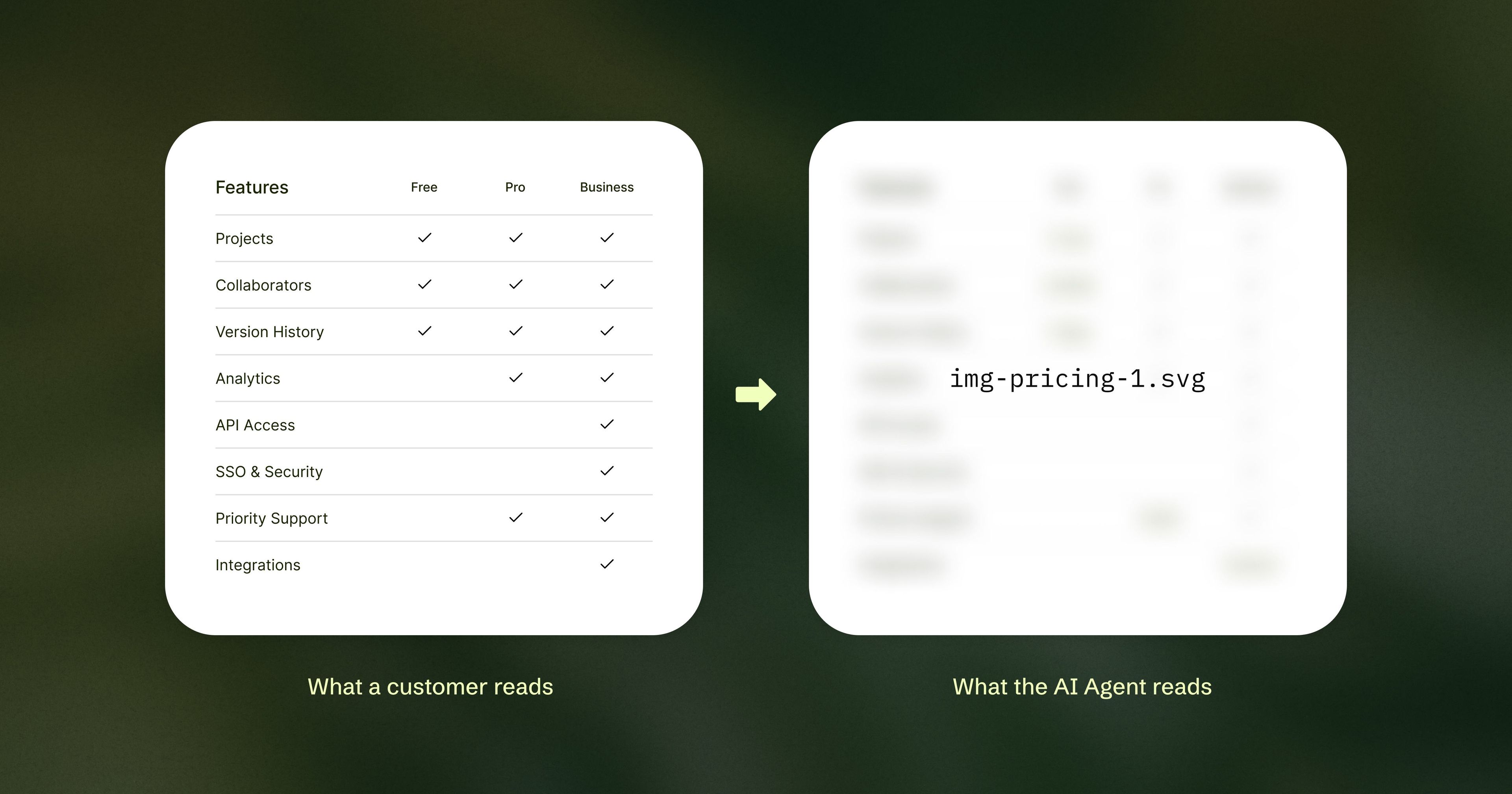
Some AI reads your site to answer questions about it, like the tools behind ChatGPT and other answer engines. They work from the words on the page, not the design. It’s a bit like reading a website with all the visuals stripped away. If a price only appears in an image or a feature is shown only as an icon, they may miss it entirely.
AI agents work differently. These are tools that act for someone: browsing pages, comparing plans, or filling out forms. Many of them read a page’s accessibility tree, the same map of headings, links, buttons, and form fields that screen readers use (software that reads websites aloud for people who are blind or have low vision).
So while the two types of AI read your site differently, they depend on the same foundation: real text instead of images of text, alt text that describes what an image shows, headings that organize the page, and buttons and form fields with clear names. Answer engines need readable text to understand what you offer. Agents need clear labels to act on it. That’s the foundation accessibility builds.
People with disabilities have always been the reason this work matters (and always will be). What’s new is that the same structure now shapes whether AI can understand your site, too. And most sites have room to improve. AudioEye’s Digital Accessibility Index found an average of 62 issues per page, with interior pages, where pricing, features, and documentation live, faring worse than homepages.
For AI agents, those gaps show up in results. An AudioEye study found that agents completed 96% of tasks on a site with accessibility fixes in place and 31% on the same site without them.
Where SaaS Sites Lose the Answer
Think back to that buyer comparing project management tools. To build their shortlist, AI has to pull the same handful of details from every vendor’s site: what it costs, what’s included in each plan, whether it works with Salesforce, whether it meets security requirements, and anything else the buyer may have asked for.
Those answers typically live on just a few pages, and they’re often the ones designed with only a human visitor in mind. Here’s what AI sees on each one:
Pricing pages. Tier cards are often built as styled graphics, so a buyer sees clean prices for each plan while AI sees a set of images. If AI can’t read your prices, it can’t include you in a price comparison.
Feature comparison tables. A grid of checkmarks is easy for people to scan, but checkmark icons without a text alternative don’t tell AI anything. It can’t tell which plan includes which feature, so it may guess, or worse, leave you out.
Integration pages. A wall of partner logos signals “we work with everything” to a person. To AI, logos with no alt text are just images. So the integration a buyer asked for in their prompt is the one AI can’t find.
Security and compliance pages. SOC 2 and ISO badges build trust at a glance, but as images alone, they’re something AI can’t confirm. When a buyer asks whether you’re SOC 2 compliant, AI may not have an answer.
Demo and trial forms. A short form looks simple until the fields have no labels and the submit button is just an icon. As agents start filling out forms for buyers, those gaps can stop a lead before it ever exists.
Each of these is a small fix, but the cost of not fixing them adds up, and you likely won’t see it happen. Google Analytics automatically excludes known bot traffic(opens in a new tab) and doesn’t show how much it removed. In G2’s interviews with software marketers(opens in a new tab), attribution came up as their most consistent frustration: they can see AI influencing the pipeline, but they can’t measure it. If you can’t measure the deals AI helps you win, you can’t see the ones it costs you either.
Before You Write Another Page for AI
Fixing the pages that win or lose your spot on the shortlist doesn’t require a new strategy or a content overhaul. It starts with the pages buyers and AI compare most: pricing, features, integrations, security, and demo or trial forms.
On each one, check two things: Is every price, plan, and feature written as real text, not built into an image? And does every button, link, and form field have a clear name? If not, start there.
Those are small fixes with big stakes. They’re the same changes people with disabilities have always needed to use your site, and now they also decide whether AI can find you, describe you accurately, and put you on the shortlist.
For years, accessibility was framed as compliance work. In an AI-first market, it’s also how you get found.
Share Article