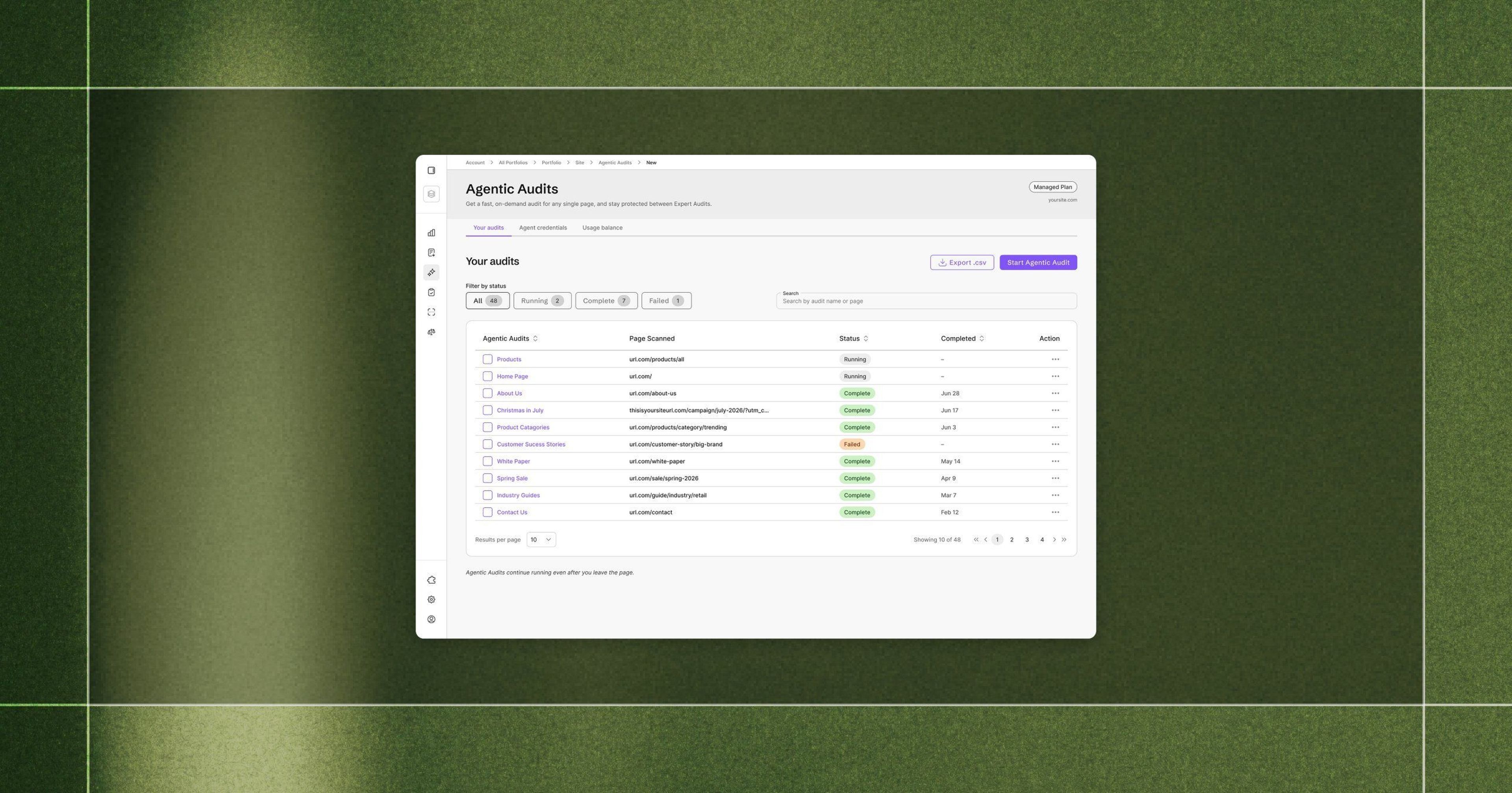
NEW: AudioEye launches Agentic Audits and SDK MCP
Read moreHow AudioEye’s Legal Support Works
AudioEye's Legal Support provides a technical resource for responding to accessibility claims in demand letters or lawsuits, backed by testing, fixes, and reporting. Submit a claim, and AudioEye evaluates each allegation, fixes what it verifies, and walks you through a technical report. Below, we’ll cover how it works, who’s eligible, what it covers, and how AudioEye Assurance fits in.
Author: Missy Jensen, Senior Content Strategist: AI Search and Discovery
Published: 11/06/2026

A demand letter doesn’t ask permission. It shows up in an inbox, cites a list of alleged Web Content Accessibility Guidelines (WCAG) violations as settled fact, and gives a deadline for a response. Most legal and compliance teams have never seen the specific allegations before, and now they face a short deadline to figure out which issues are real.
That gap, between “a claim just arrived” and “we know what to do about it,” is what AudioEye’s Legal Support is built to close. Our legal support gives customers a technical resource to respond to accessibility claims in demand letters or lawsuits, backed by testing, fixes, and in-depth reporting.
What is AudioEye Legal Support?
AudioEye Legal Support gives customers a technical resource to respond to accessibility claims in demand letters or lawsuits, backed by testing and evaluated by AudioEye’s internal team, rather than leaving you to decipher them. Legal Support is included automatically as a component of Audit with Custom Fixes, AudioEye’s expert audit and fix offering.
A demand letter doesn’t come with an answer key. Someone has to determine, allegation by allegation, whether it reflects a real WCAG failure or a boilerplate list generated by a scanning tool. Legal Support puts that determination in the hands of the same team that already knows the site, instead of your own developers or an outside firm brought in under deadline pressure.
How Does AudioEye Legal Support Work, Step by Step?
When a customer submits an accessibility demand letter or files a lawsuit, AudioEye evaluates each alleged WCAG issue using assistive technology, fixes verified issues, delivers a technical report on the findings, and walks through the results step by step.
The process typically runs in five steps:
Submit the claim. The customer sends the demand letter or lawsuit to AudioEye through the Request Legal Support Services page.
AudioEye evaluates each allegation. AudioEye’s team tests every claimed WCAG issue using assistive technology, encountering the page as a screen reader or keyboard-only user would.
AudioEye fixes or provides fix guidance for verified issues. Confirmed issues either get fixed through AudioEye’s custom fixes or are reported as source-level guidance that your developers can apply directly.
AudioEye delivers a technical report. The report lays out which allegations were valid, which weren’t, and what’s been fixed.
AudioEye walks through the findings. A follow-up call covers what we found and answers your questions before you respond to the claim.
From here, you and your legal counsel take the technical report and shape the response to the demand letter or lawsuit.
Who is Eligible for AudioEye Legal Support?
AudioEye’s Legal Support is included automatically with AudioEye’s Audit with Custom Fixes offering. Every customer receives the same in-depth Legal Support, regardless of company size or price point. Eligibility is tied to the product, not to how big your business is or what you pay. A small business and an enterprise on Audit with Custom Fixes receive the evaluation, fixes, reporting, and walkthrough when a claim arrives.
AudioEye Legal Support activates when you receive a third-party demand letter or lawsuit, the claim alleges WCAG issues, and the issues are on a domain covered by the Audit with Custom Fixes offering.

What Does Legal Support Cover, and What’s Outside Its Scope?
AudioEye Legal Support covers demand letters and lawsuits alleging violations of WCAG 2.1 or 2.2 Level A and AA. The claim can be brought under the Americans with Disabilities Act (ADA) or a similar federal or state accessibility statute, such as California’s Unruh Act. That’s the claim scope: a specific standard, under a specific set of laws.
Content AudioEye Reports on, but Doesn’t Fix
Some content sits outside what AudioEye’s platform can fix directly, including:
PDFs and other documents: these are handled by our Document Remediation Services.
Video and multimedia, including third-party embeds, are handled by closed captioning services.
Non-website applications, such as mobile apps, which are handled separately under mobile accessibility audits.
Linked third-party domains that you don’t control.
Third-party widgets, plug-ins, and iframes built and maintained outside your codebase.
Flash content.
Java applications that open in a separate window.
AudioEye still reports on claims involving these issues. The report flags each one as something you need to address at the source code level, or with the third party that controls the content.
Does Legal Support Prevent Lawsuits?
AudioEye's Legal Support doesn't prevent lawsuits or demand letters. It gives you a fast technical response when one arrives, with each allegation evaluated, verified issues fixed, and documentation you can use in responding to the claim.
When a claim lands, you need a team that has seen this before. AudioEye has reviewed and reported on more than 2,600 legal claims since 2022, so the issues in your demand letter are likely familiar ground. Babylon Marine is one example: AudioEye helped them respond to a legal claim, and the case was dismissed without a settlement.
“We appreciate how AudioEye stepped in to stand by their work and how effective they were in resolving the claim. AudioEye was an invaluable partner through the entire process.”
— Andrew Mirra, Babylon Marine
If you've already been sued, the most pressing question is often how to prove your website is ADA compliant. That question comes up most often in e-commerce, which accounted for 78% of 2025 accessibility lawsuits, and most of those were filed in state rather than federal court. But wherever a claim is filed, answering it takes documentation: which alleged issues are valid, which aren't, and what's already been fixed. That's exactly what the technical report gives you.
What you can do before a claim arises is reduce your legal accessibility risk. AudioEye customers get up to 400% more protection against legal claims than other solutions. And Protection Status gives you a real-time view of your website's protection status, including which accessibility issues still need to be fixed, so you can see what's left and take care of it on your own timeline.
“Working with AudioEye helped us save money and time on organizing and corresponding with the Plaintiff. Overall, it saved us from anxiety about being hit with another lawsuit.”
— Melissa R., Brand Manager, Gendarme
How Does AudioEye Assurance Add Financial Protection?
AudioEye Legal Support provides the technical response to a claim. At the same time, AudioEye Assurance provides limited financial protection covering all or a portion of a settlement payout for qualifying WCAG-related claims. Assurance sits on top of Legal Support. It doesn’t replace the evaluation, fix, and reporting process described above.
What Does Legal Support Change for You?
Most businesses find out how prepared they are on the day a demand letter arrives. With AudioEye Legal Support, that day looks different. The technical side of your response is already in place and included with Audit and Custom Fixes. There's no outside expert to find, vet, or bring up to speed while the clock is running.
That changes the conversation that comes next. Instead of reacting to a list of allegations you can't verify, your team responds with facts: what AudioEye found, what it fixed, and what's left for you to address. And with AudioEye Assurance, financial protection sits on top of that response for qualifying claims.
See how Legal Support works. Talk to an expert now.
Frequently Asked Questions
Share Article